🧠💰 How to Win Research Grants in 2026 (Without Losing Your Sanity): An AI-Powered Playbook

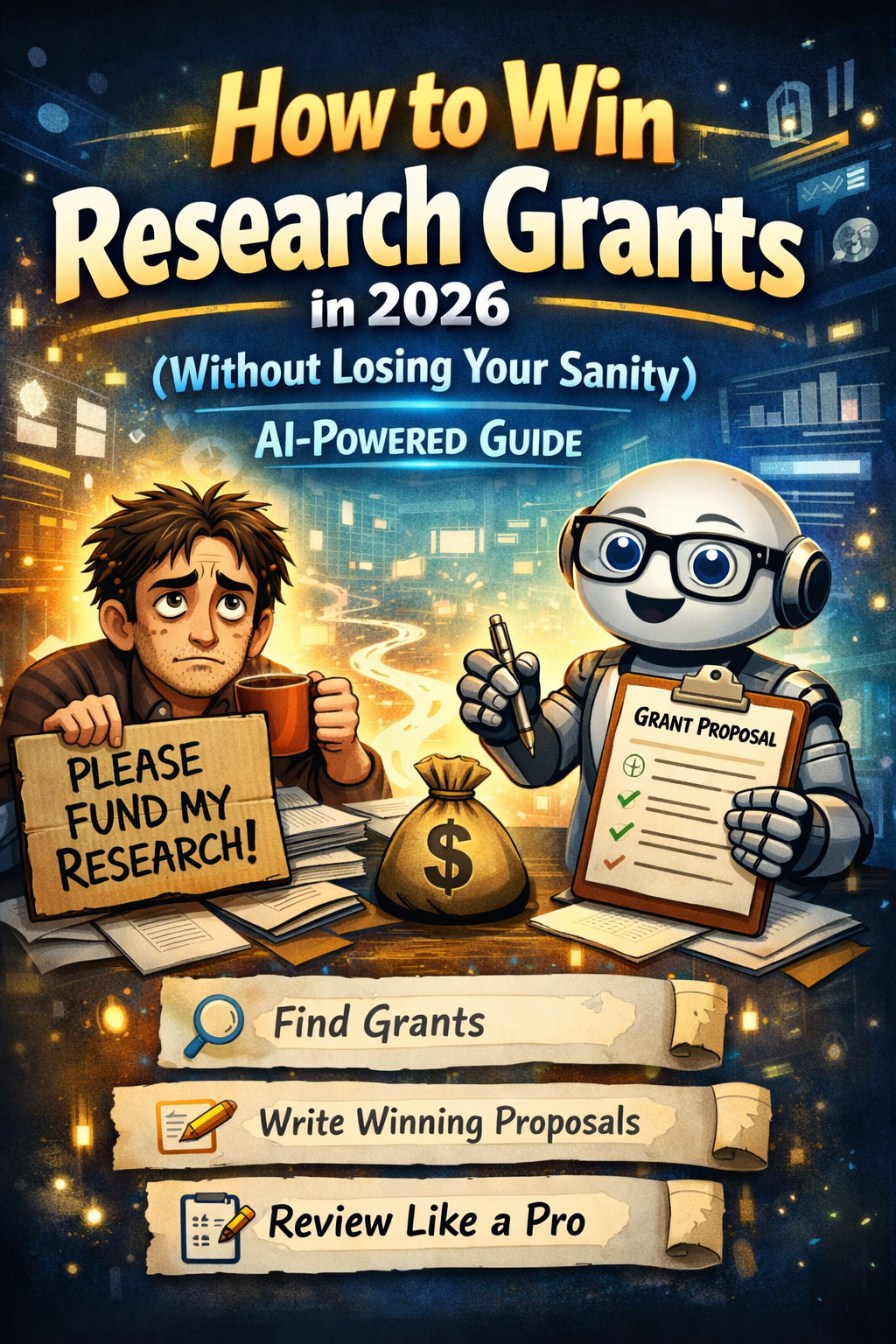
Let’s be honest.
If you want to do research, you need money.
And to get money, you must beg for it politely.
Welcome to academia’s most sacred ritual: grant writing—also known as academic panhandling.
The good news?
If you were doing this in 2010, you were doomed.
If you’re doing this in 2026, you have AI on your side.
Here’s a no-nonsense, AI-first workflow to find grants, draft them faster than ever, and review them like a seasoned panelist without burning out your brain.
Step 1: Finding Grants (AKA: Who’s Got the Money?)
Finding grants used to mean scrolling ancient databases and praying. Now? AI does the hunting.
🔍 SciSpace (Free & Powerful)
SciSpace has an Agent Gallery where researchers build AI agents for specific tasks—including grant discovery.
How to use it:
- Go to SciSpace
- Navigate to Agent Gallery
- Search for “Grant” or “Funding”
- Try agents like:
- Grant Finder
- AI Grant Writer
- Discipline-specific funding tools
💡 Think of it as Google Scholar, but caffeinated.
🎯 Thesify (Ridiculously Underrated)
This one is genuinely clever.
Upload one of your papers, and Thesify will:
- Analyze your research themes
- Match them to relevant grants
- Show deadlines, opening dates, and relevance scores
- Recommend journals, conferences, and funding sources
If your paper matches a grant by 70%+, that’s a serious signal.
💡 Best for researchers who already publish.
Step 2: Drafting the Grant (Without Starting From Zero)
A grant is not just “the idea.”
It’s:
- Your background
- Your institution
- The project
- The timeline
- The budget
- The impact
- The risk management
- The outputs
This is where AI shines.
✍️ SciSpace Grant Writer Agent
👉 https://www.scispace.com/agents
SciSpace lets you prompt an AI agent to draft entire academic grant applications.
Example prompt:
“Create a persuasive NSF -style grant application.
Find my Google Scholar profile.
Establish my academic credentials.”
What it does:
- Pulls your publications
- Builds project objectives
- Drafts background & significance
- Adds risk management and budget logic
- Structures the application like a real grant
⚠️ Not submission-ready
✅ An excellent first draft
Starting with something imperfect is infinitely better than starting with nothing.
🚀 Grantable (One of the Best for Academia)
Grantable is one of the few AI tools that actually understands academic grants, not just startups or nonprofits.
You can generate:
- Letters of Intent (LOI)
- Budget narratives
- Project descriptions
- Grant refinements
- Source-backed sections
It also includes a Grant Discovery (Beta) feature—especially useful if you’re US-based.
💰 Relatively affordable compared to most academic tools.
Step 3: Finding Literature (Fast, Smart, Defensible)
No grant survives without citations.
Your AI-powered literature stack should include:
- Google Scholar
👉 https://scholar.google.com - Consensus
👉 https://consensus.app - Elicit
👉 https://elicit.org - Litmaps
👉 https://www.litmaps.com - Research Rabbit
👉 https://www.researchrabbit.ai - Connected Papers
👉 https://www.connectedpapers.com
AI doesn’t replace judgment—but it compresses weeks of searching into hours.
Step 4: Reviewing Your Grant Like a Panelist (The Sneaky Part)
This is where most people fail—and where AI gives you an unfair advantage.
Every funding agency publishes:
- Reviewer guidelines
- Scoring rubrics
- Assessment criteria
These documents tell reviewers exactly what earns a high score.
🧪 The Power Move
- Download the peer reviewer / assessor guide for your grant
- Upload it into one of these tools:
- ChatGPT → https://chat.openai.com
- NotebookLM → https://notebooklm.google.com
- Claude → https://claude.ai
- Gemini → https://gemini.google.com
- Upload your draft grant
Ask:
“Have I satisfied every criterion required for the highest possible score?”
Now your AI becomes:
- A mock reviewer
- A compliance checker
- A brutally honest editor
🎯 Your goal is simple:
Make the reviewer’s job effortless.
Why This Works (And Why It’s Ethical)
You’re not cheating.
You’re reverse-engineering clarity.
Reviewers are human:
- Overworked
- Underpaid
- Reading hundreds of proposals
If your grant screams “YES, I HIT ALL YOUR CRITERIA”, you win.
Final Thought: Use Your Brain for What Matters
AI should not replace thinking.
It should replace suffering.
Let the tools:
- Generate drafts
- Find grants
- Cross-check criteria
You focus on:
- Ideas
- Strategy
- Refinement
- Impact
Because editing something is far easier than creating it from nothing